
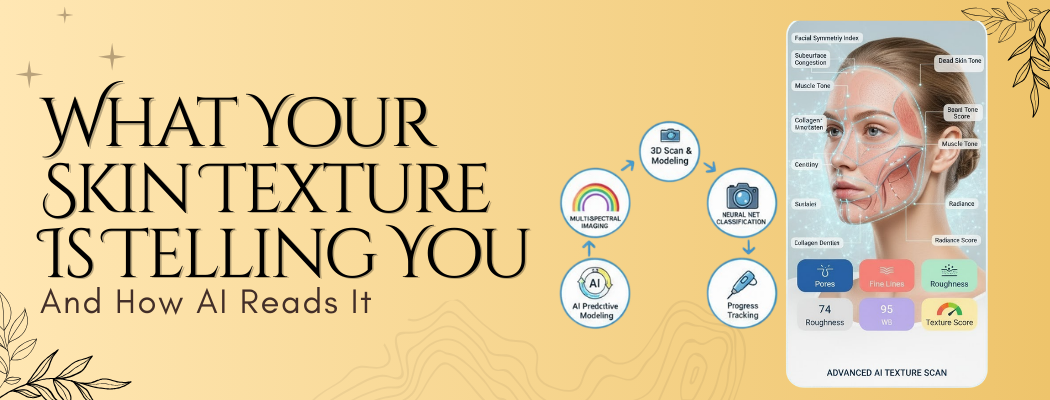
Your skin's texture is more than a cosmetic concern — it is a living record of everything from your hydration levels and hormonal health to environmental damage and cellular turnover. Learning to decode what your skin texture is telling you, and pairing that knowledge with AI-powered analysis, is the new frontier of personalised skincare.
What exactly is skin texture?
Skin texture refers to the surface quality of your skin — how it looks, feels, and behaves under different conditions. Smooth, even-toned skin with minimal visible pores is generally considered healthy, while bumps, roughness, enlarged pores, dry patches, or uneven tone signal that something beneath the surface needs attention.
Unlike skin type (oily, dry, combination, or normal), skin texture is dynamic. It shifts with the seasons, your diet, stress levels, sleep quality, and age. This is why a one-size-fits-all skincare routine will always fall short. Your texture is personalised data — and it deserves a personalised response.
The 6 most common texture concerns and what they signal
Texture 01: Rough or bumpy surface
Often linked to a build-up of dead skin cells, dehydration, or keratosis pilaris. Your barrier may be compromised, or cell turnover has slowed.
Texture 02: Enlarged pores
Excess sebum production, sun damage, or reduced skin elasticity stretches pore walls. Often associated with oily skin types or collagen loss in mature skin.
Texture 03: Fine lines and crepiness
A sign of declining collagen and elastin, UV-induced damage, or chronic dehydration. Often appears first around the eyes and forehead.
Texture 04: Uneven skin tone
Hyperpigmentation, post-inflammatory marks, or melasma creates uneven patches. Often triggered by sun exposure, hormonal shifts, or acne scarring.
Texture 05: Dullness and lack of glow
Congested skin, poor lymphatic drainage, nutritional deficiencies, or insufficient hydration. A classic sign that cellular oxygen and renewal are below par.
Texture 06: Persistent redness or blotchiness
Can indicate rosacea, sensitivity, or a disrupted skin barrier. Inflammatory responses are often driven by incorrect product use or environmental triggers.
Most people experience a combination of these texture concerns simultaneously, which is exactly why identifying them accurately — without guesswork — matters so much.
Why your eyes alone are not enough
The human eye is remarkable, but it is not calibrated for precision skin assessment. Under natural light in a mirror, we miss subtle pigmentation, micro-texture inconsistencies, early-stage dehydration, and sub-surface changes in firmness that don't yet show visibly. Dermatologists have trained for years to identify these nuances — but most people don't have access to a dermatologist every week.
This is where artificial intelligence changes everything. AI models trained on millions of skin images can process texture data at a granularity the human eye simply cannot match — detecting patterns in pore size distribution, measuring the statistical variance in pigmentation across zones, and quantifying firmness loss percentages. The result is a map of your skin that is both highly detailed and instantly actionable.
"Skin texture analysis is not about vanity — it is diagnostic. When AI can measure smoothness, hydration depth, and cellular oxygen simultaneously, it gives you the same quality of information a dermatologist gathers over a full consultation — in seconds."
How Oreal AI reads your skin texture in real time
Oreal AI skin analyser is built around 12 core skin health parameters, each of which directly relates to texture, health, and appearance. Using a single face scan — captured through your device camera or an uploaded photo — the algorithm evaluates your skin across every one of these dimensions.
Smoothness: Surface uniformity and micro-texture consistency
Hydration: Water content and barrier function indicators
Firmness: Collagen density and elasticity readings
Pigmentation: Melanin distribution and dark spot mapping
Redness: Vascular visibility and inflammatory markers
Pore analysis: Pore size, density, and sebum congestion
Dark circles: Periorbital pigmentation and vascular depth
Wrinkles: Fine line depth and dynamic crease patterns
Oxygen level: Skin radiance and cellular oxygenation proxies
Acne score: Active blemishes, comedones, and inflammation
Dark spots: Post-inflammatory hyperpigmentation mapping
Uneven tone: RGB variance and colour uniformity index
Each score is contextualised against your age, gender, and skin type — so rather than a generic assessment, you receive insights calibrated to what is genuinely expected and healthy for your skin profile specifically.
From texture score to targeted routine
Understanding your skin texture is only half the equation. The real power of AI skin analysis lies in what it recommends next. Oreal's engine translates raw parameter scores into targeted, prioritised skincare guidance — identifying which concerns need immediate attention and which are trending positively.
Capture — one scan, complete data
Upload a clear, well-lit photo or use your device camera. The AI maps over 40 facial zones in a single image frame.
Analyse — parameters scored instantly
The model compares your skin against its trained dataset, scoring each parameter relative to your demographic baseline.
Prioritise — surface what needs work most
Your results are divided into what's working well and the areas requiring attention, in priority order.
Act — receive your personalised score sheet
A complete score report is sent to your email, forming the foundation of a data-driven skincare routine you can track over time.
The role of AI in the future of skin health
We are at an inflection point in skincare. For decades, product recommendations were based on broad skin type categories — oily, dry, combination — which tells us very little about the actual state of an individual's skin on a given day. AI skin analysis collapses this gap entirely.
Platforms like Oreal.app are making professional-grade skin assessment accessible to everyone — not just those who can afford regular dermatology appointments. By integrating AI into the daily skincare decision loop, individuals can move from reactive routines (treating visible problems after they appear) to proactive care (preventing issues before they develop, based on early-warning texture signals).
For beauty brands and clinics, the implications are equally profound. Embedding an AI skin analyser into the customer journey — whether in a retail app, a spa booking flow, or an e-commerce product finder — transforms generic product recommendations into personalized prescriptions. The result is higher customer confidence, fewer returns, and measurably better outcomes.
Analyse your skin texture right no
Get your personalised 12-parameter skin health report in under 60 seconds — free.
Tips to improve skin texture based on your AI results
If your smoothness score is low
Introduce a gentle chemical exfoliant (AHA or BHA) two to three times per week. Look for ingredients like glycolic acid, lactic acid, or salicylic acid depending on whether your texture concern is surface-level or pore-deep.
If your hydration score is low
Layer a humectant serum (hyaluronic acid, polyglutamic acid) beneath a ceramide-rich moisturiser. Hydration scores reflect both water content and barrier integrity — so barrier repair is just as important as adding water.
If your pigmentation or dark spots score is low
Consistent broad-spectrum SPF is non-negotiable — UV exposure is the primary driver of pigmentation. Add a vitamin C serum in the morning and consider niacinamide as a brightening booster in your PM routine.
If your firmness score is declining
Retinol or retinoids remain the gold standard for stimulating collagen production. Peptide serums and gua sha massage techniques can complement topical activities by improving microcirculation and lymphatic drainage.
Conclusion
Your skin texture is a rich, real-time data source — one that most people have never been equipped to properly decode. With AI skin analysis tools like Oreal.app, that gap is closing rapidly. By scanning your face, receiving scored insights across 12 health parameters, and acting on personalised guidance, you are no longer relying on guesswork or generic advice. You are practising evidence-based skincare — and your skin will reflect the difference.
Frequently Asked Questions
What is skin texture analysis and how is it different from skin type?
Skin type (oily, dry, combination, normal) describes your skin's general baseline behaviour — primarily how much sebum it produces. Skin texture analysis goes much deeper, assessing real-time qualities like smoothness, hydration levels, pore size, pigmentation distribution, firmness, and more. While your skin type is relatively stable, your texture changes constantly and can reveal temporary or chronic issues that skin type classification misses entirely.
How accurate is AI skin texture analysis compared to a dermatologist?
AI skin analysers like Oreal AI are trained on extensive datasets of clinically validated skin images and achieve high accuracy for the parameters they measure — including hydration proxies, pigmentation mapping, smoothness scoring, and wrinkle depth. They are designed to complement professional dermatological care, not replace it for clinical diagnoses. For general skincare guidance, texture tracking, and product recommendation, AI analysis is highly reliable and consistent.
What does a low smoothness score on Oreal AI indicate?
A low smoothness score typically indicates surface roughness caused by dead skin cell accumulation, dehydration, or disrupted skin barrier function. It may also reflect early signs of keratosis pilaris, sun damage, or reduced cellular turnover. Oreal's recommendation engine uses this score alongside your other parameters to suggest appropriate exfoliation, hydration, and barrier repair strategies.
How often should I scan my skin with Oreal AI?
For ongoing skincare optimisation, a scan once every four to six weeks is ideal. This interval allows enough time for your routine changes to produce measurable results across parameters like hydration, smoothness, and pigmentation. If you have introduced a new active ingredient or changed your diet significantly, you may wish to scan sooner to track the impact.
Can Oreal AI analyse skin texture for all skin tones?
Yes. Oreal's AI model is trained across diverse skin tones and ethnicities to ensure equitable, accurate analysis regardless of your complexion. The skin health parameters are calibrated to account for the way different Fitzpatrick skin types express texture, pigmentation, and vascular changes — ensuring results that are relevant and actionable for all users.